 AI Affiliate
Dify Affiliate Program for AI Workflow, Agent, and Developer Audiences
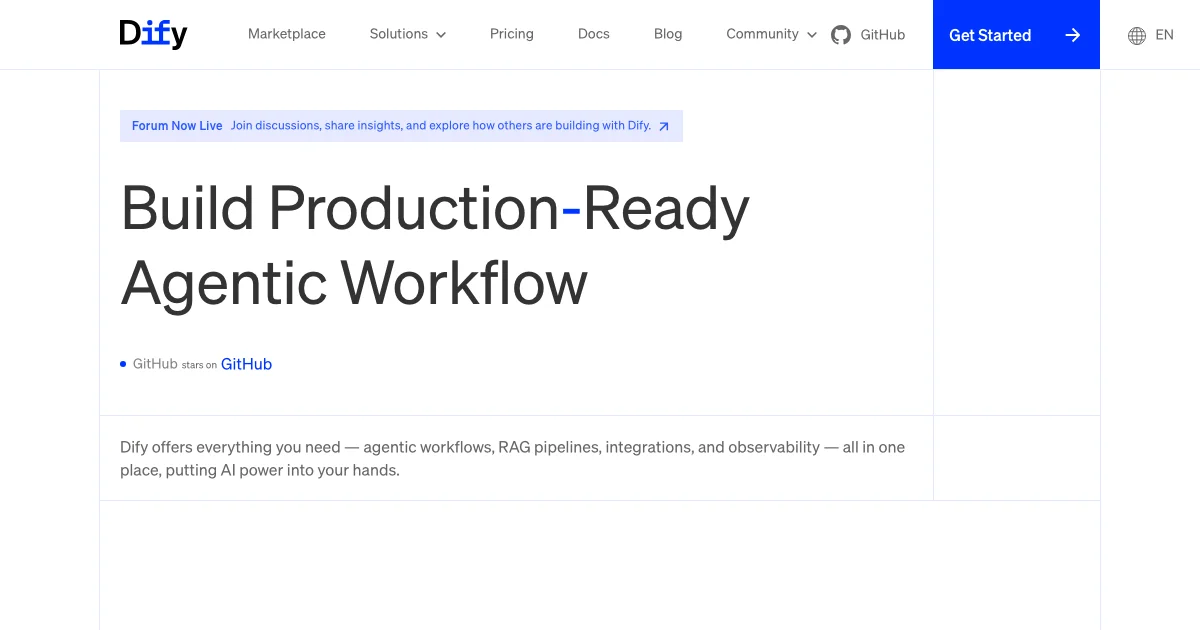
Dify is an open-source platform for building, deploying, and operating AI agents, RAG pipelines, and model-powered applications with visual workflows and APIs.
Stay updated on Dify
Get an email only when the official affiliate page changes.
Monitor my affiliate linkPricing & Commission
💡 We may earn a commission if you join. No extra cost to you.
Why Promote Dify?
Dify is a strong fit for AI-builder and developer audiences because its current workflow product exposes the parts of an LLM application that are worth inspecting. First-party pages show visual workflows with model nodes, knowledge retrieval, tools, code, branching, triggers, human review, debugging, versions, observability, and publishing as an app, API, MCP server, or template. Developer educators, automation consultants, AI-agent builders, and technical teams can build one bounded workflow and show where data, tools, branching, review, and monitoring change the result instead of presenting Dify as a generic no-code promise.
Dify's official affiliate launch says commission starts at 30% and rises to 50% after the first 20 paid referrals, with subscription commission for the first 12 months. The governing Affiliate Program Agreement also fixes the commission period at 12 months, but says the applicable commission rate and an affiliate lead's validity window are controlled by the Affiliate Tool or Program Policies.
That creates a material attribution-policy gap versus the launch post's broader lifetime-attribution wording. Current payout timing is defined as within 45 days after month-end, but the lead window remains portal-defined, so the record stays recheck.
Pros & Cons for Affiliates
Pros
- Dify's official affiliate launch publishes a 30% starting rate and a 50% rate after the first 20 paid referrals.
- The governing agreement defines a 12-month commission period after conversion and a payment process within 45 days after month-end.
- Workflows, knowledge retrieval, tools, code, human review, debugging, observability, APIs, and MCP publishing support technical demonstrations with real information gain.
Cons
- The legal agreement makes lead validity and the applicable commission rate operational parameters of the Affiliate Tool or Program Policies rather than fixed public constants.
- The official launch describes lifetime attribution after a click, while the legal agreement says affiliate leads expire according to a tool-defined validity window before conversion.
Who Should Promote This?
Developer educators, AI-agent builders, automation consultants, technical SaaS reviewers, course creators, and teams whose audiences build production-oriented LLM applications or internal AI workflows.
The strongest content builds one bounded application with retrieval, tools, branching, and review, then shows debugging and observability so readers can evaluate the engineering workflow rather than a prompt-only demo.
How to Promote Dify
Best content types
- LLM workflow build walkthrough
- AI application platform comparison
- Agent-to-API deployment tutorial
Recommended angle
Build one small but complete workflow with a model, knowledge or tool access, branching, and human review, then show debugging, versioning, and the path to an API or hosted app.
Conversion tips
- Explain the published 30%-to-50% launch structure and the 12-month commission period, while making clear that the legal agreement defers the live rate and lead-validity window to program tooling or policies.
- Do not present lifetime attribution as fully reconciled while the governing agreement still defines a pre-conversion lead-expiry rule.
Dify AI Alternatives
Discover AI tools alternative to Dify


