 AI Affiliate
SocialRails Affiliate Program: 50% Lifetime Recurring
SocialRails is an AI social media platform for planning, generating, scheduling, and repurposing brand content across multiple channels.
Stay updated on SocialRails
Get an email only when the official affiliate page changes.
Monitor my affiliate linkPricing & Commission
💡 We may earn a commission if you join. No extra cost to you.
Why Promote SocialRails?
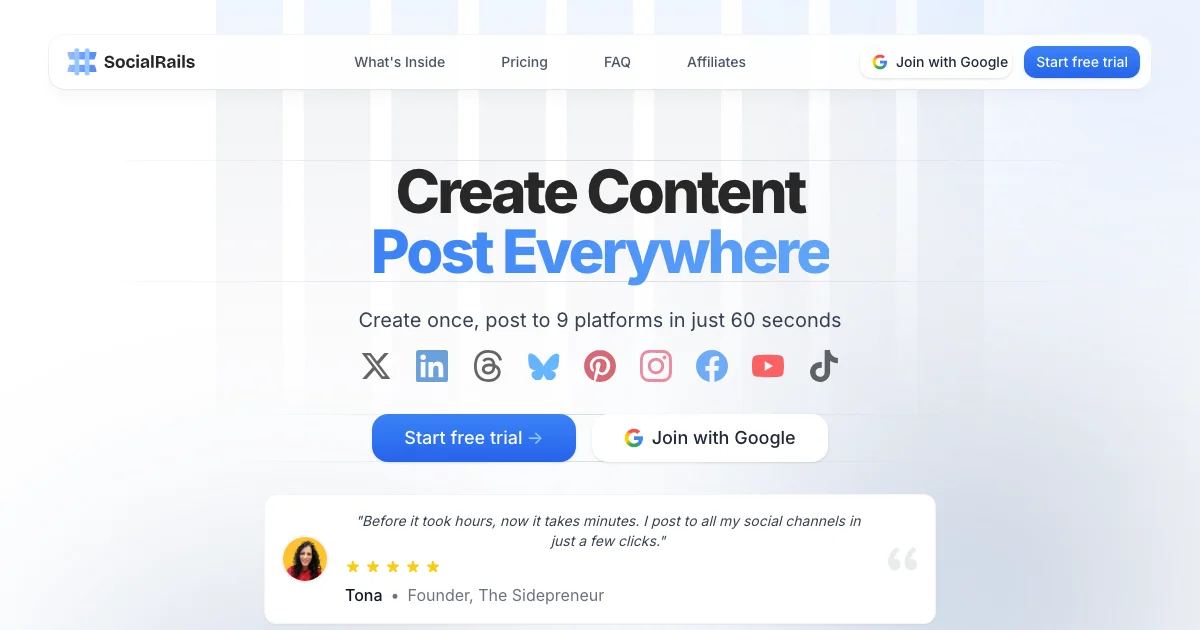
SocialRails is straightforward to demonstrate because its product promise maps to a visible creator workflow: create content once, then schedule it across multiple social platforms. The current product supports nine platforms, AI-assisted content and images, short-form video creation, a drag-and-drop calendar, recurring posts, timing suggestions, and analytics. Monthly plans currently span $29 Creator, $49 Business, and $99 Agency.
Its affiliate terms are also unusually complete on the public page. SocialRails states 50% lifetime recurring commission, a 30-day attribution window, first-click attribution, and Net-30 payment terms.
The FAQ adds a $50 minimum, monthly PayPal payments, and a 30-day hold before commission release. It describes bloggers, influencers, agencies, and other audience owners interested in social media management as eligible participants.
The best affiliate content should make the time-saving claim tangible. Build a week or month of posts, demonstrate cross-platform adaptation, compare how many workspaces or social connections each plan supports, or show the AI video workflow from input to scheduled post. Agency content can focus on client-workspace handling, while creator content can focus on consistent publishing and reuse.
The public affiliate page does not spell out a broader paid-search, coupon, or trademark policy, so do not assume permissions that are not published there. Keep promotion centered on product demonstrations, audience fit, and the terms SocialRails actually states. A clear disclosure and realistic examples are more defensible than passive-income promises, even with a lifetime recurring structure.
Pros & Cons for Affiliates
Pros
- 50% lifetime recurring commission with a published 30-day attribution window and first-click model.
- $50 minimum, monthly PayPal payouts, Net-30 terms, and a 30-day hold are publicly documented.
- Creator, business, and agency workflows offer clear product demonstrations and audience segmentation.
Cons
- The public affiliate page does not publish a broader paid-search, coupon, or trademark-bidding policy.
- A 30-day hold and $50 minimum mean smaller affiliates may wait before commissions become payable.
Who Should Promote This?
Social-media educators, creator-economy publishers, small-business marketing sites, agencies, freelancers, and consultants who can demonstrate scheduling or content-production workflows.
How to Promote SocialRails
Best content types
- Social media scheduler review
- SocialRails vs. scheduling tool comparison
- 30-day content planning tutorial
- Agency workflow demo
- AI short-form video tutorial
Recommended angle
Quantify the workflow: create and schedule a real content batch across several platforms, then map Creator, Business, or Agency to the reader's operating model.
Conversion tips
- Use a before-and-after workflow showing how many posting steps move into one calendar.
- Segment content by solopreneur, growing team, and agency needs instead of treating all plans as interchangeable.
- State the first-click, 30-day, Net-30, hold, and $50 threshold mechanics clearly so earnings expectations stay realistic.
SocialRails AI Alternatives
Discover AI tools alternative to SocialRails